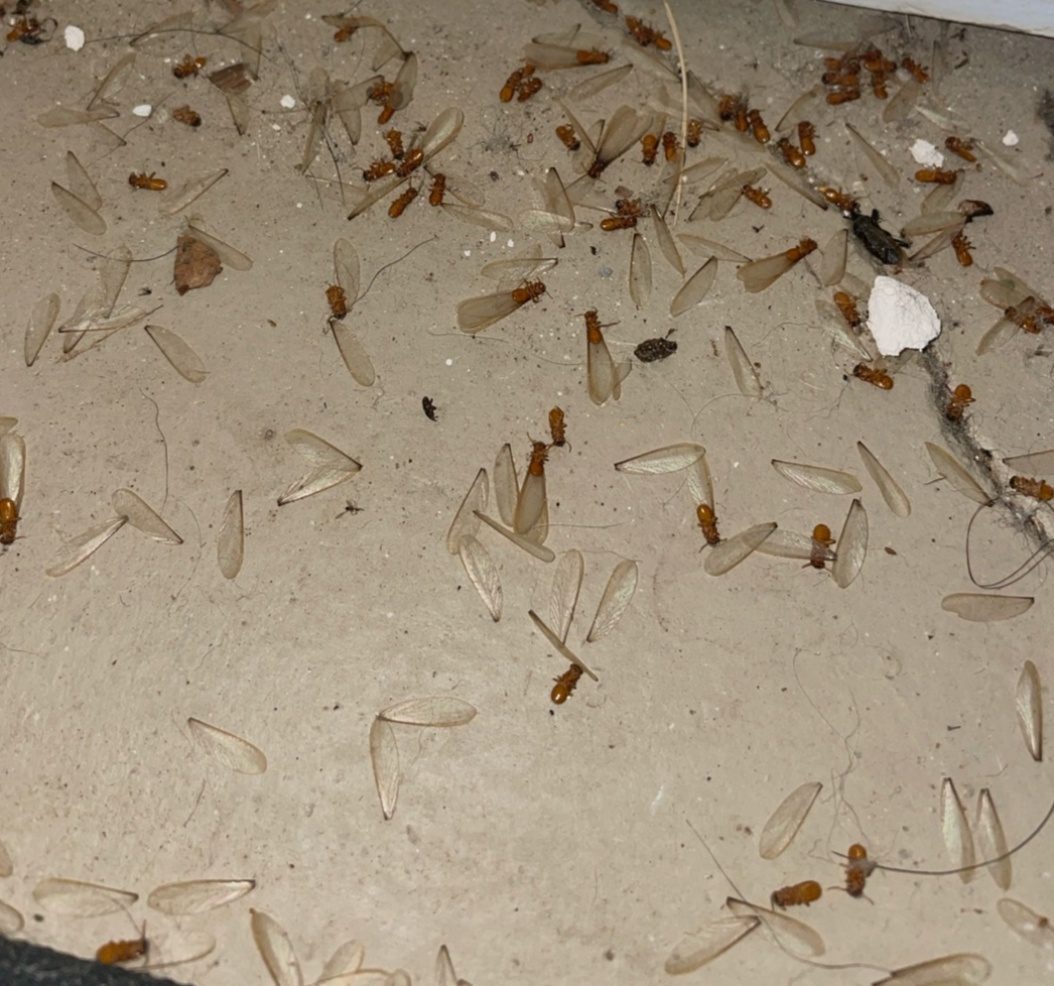
Every spring, millions of termites take flight across Northwest Florida and Coastal Alabama. These swarmers — winged reproductive termites — are looking to establish new colonies, and your home could be their next target.
Termite swarmers are the reproductive members of an established colony. When a colony matures (typically after 3-5 years), it produces winged termites that emerge in large numbers, usually after a warm rain. Their goal is to pair up, shed their wings, and start a new colony.
On the Gulf Coast, Eastern Subterranean termites typically swarm from February through May, with peak activity in March and April. Formosan termites swarm later, usually May through June, and often at night near lights. Drywood termites may swarm from April through November.
If you notice discarded wings near windowsills, doors, or light fixtures, this is a strong indicator of swarming activity near your home. Other signs include mud tubes on foundation walls, hollow-sounding wood, and small piles of frass (drywood termite droppings).
First, don't panic. Seeing swarmers doesn't necessarily mean your home is infested, but it does mean there's an established colony nearby. Collect a few specimens in a plastic bag and call EnSec for a free termite inspection. Our specialists can identify the species and recommend the right treatment approach.
Keep mulch at least 12 inches away from your foundation. Fix leaky faucets and ensure proper drainage around your home. Store firewood away from the house. Consider a preventive termite treatment plan if your home isn't currently protected.
Don't wait until you see damage. Call EnSec at 850-821-2215 for a free termite inspection.
Eastern subterranean termites swarm February through May (peak March–April), Formosan termites swarm May through June and often at night near lights, and drywood termites may swarm April through November.
Swarmers are the winged reproductive termites a mature colony (typically 3–5 years old) releases to pair off and start new colonies, usually after a warm rain.
Don't panic. Collect a few specimens in a bag and call for a free inspection — swarmers indicate an established colony is nearby, even if your home isn't yet infested.
Keep mulch at least 12 inches from the foundation, fix leaks, ensure good drainage, store firewood away from the house, and consider a preventive termite treatment plan.
EnSec Pest & Lawn has been protecting Gulf Coast homes since 1997. Get a free estimate today.
