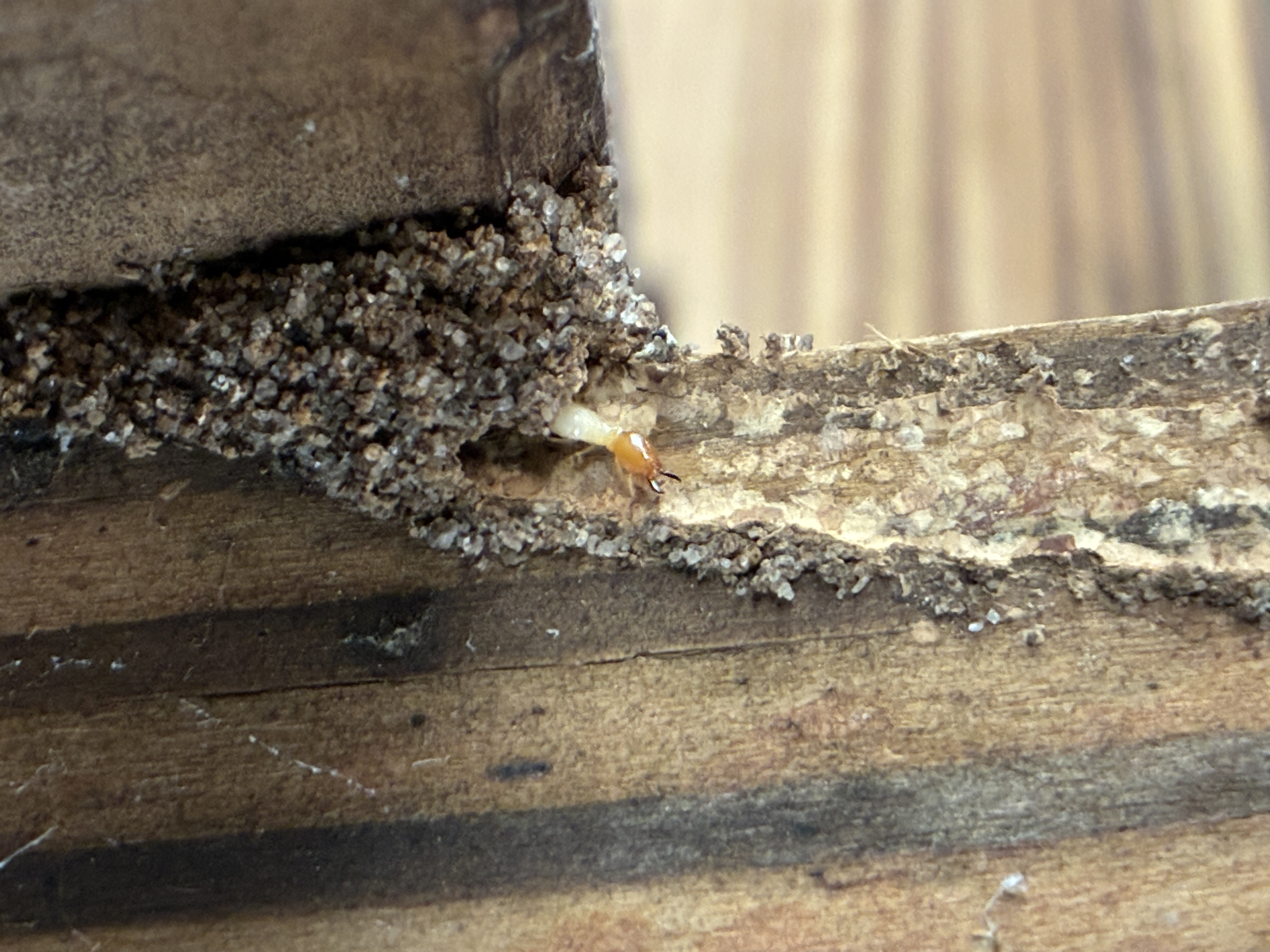
In February 2026, our EnSec technicians discovered active Formosan subterranean termite activity inside a residential structure in Gulf Breeze, Florida (ZIP code 32563). The photo above captures one of the colony's soldier termites emerging from a damaged wood joint — a telltale sign of an infestation.
Formosan subterranean termites (Coptotermes formosanus) are considered the most destructive termite species in the United States. Originally from East Asia, they arrived in the Gulf Coast region through port cities and have since established massive colonies throughout Northwest Florida and Coastal Alabama. A single Formosan colony can contain several million individuals — compared to roughly 300,000 for a native Eastern Subterranean termite colony — and can consume wood at a dramatically faster rate.
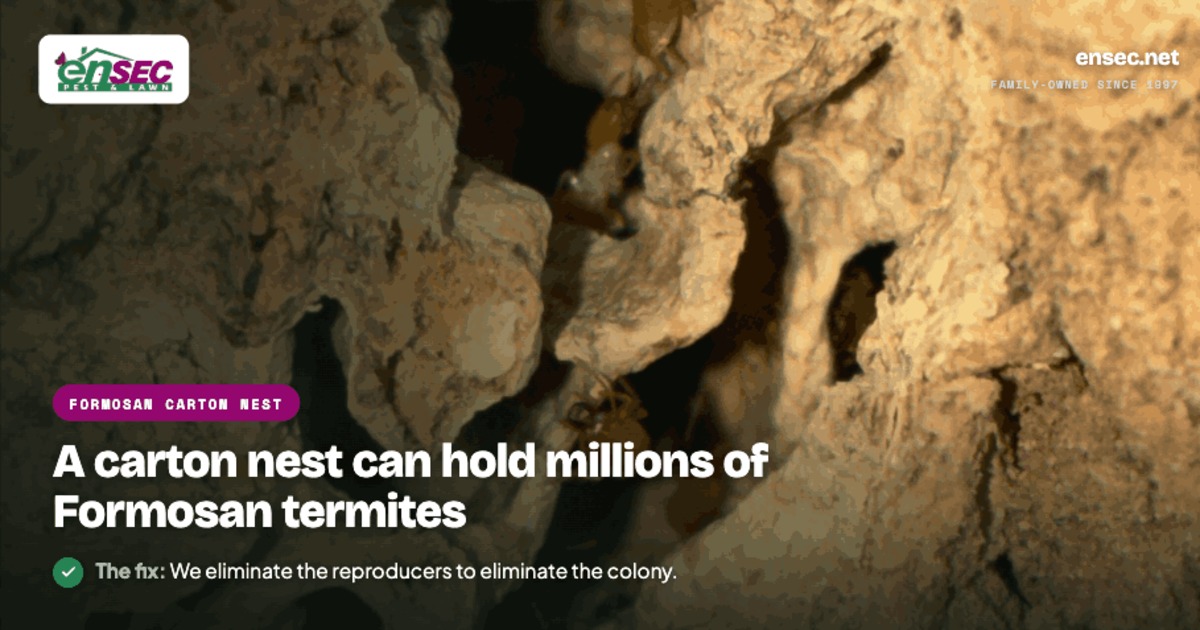
Every termite colony is organized into castes, each with a specialized role. Workers forage for food, reproductives (kings, queens, and alates) handle colony expansion, and soldiers defend the colony from threats — primarily ants, which are the termite's most common natural predator.
Formosan soldiers make up roughly 10 to 15 percent of the colony population, which is a significantly higher ratio than most other termite species. This larger defensive force is one reason Formosan colonies are so aggressive and resilient. When a mud tube or gallery wall is breached, soldiers rush to the opening, positioning their heads to block the gap while workers repair the damage behind them.
The Formosan soldier's primary weapon is a fontanelle gland located on the top of the head. When threatened, the soldier secretes a white, glue-like substance called defensive secretion (or fontanellar secretion) through a small pore on the forehead. This sticky fluid entangles and immobilizes attacking ants, making it far more effective than the simple biting defense used by Eastern Subterranean soldiers.
When a pest control professional discovers termite activity during an inspection, one of the first steps is species identification. Different termite species require different treatment strategies, and Formosan infestations typically demand more aggressive intervention due to the colony's size and destructive capacity.
Identifying the soldier caste is the fastest and most reliable field identification method. Here's what sets Formosan soldiers apart:
Head shape: Formosan soldiers have a distinctive oval or teardrop-shaped (egg-shaped) head that rounds at the front. In contrast, Eastern Subterranean soldiers have rectangular heads with straight, parallel sides.
Head color: Formosan soldier heads are a deep orange to amber color. Eastern Subterranean soldiers tend to have darker, more brownish-black heads.
Mandibles: Formosan soldiers have curved, sickle-shaped mandibles without teeth. Eastern Subterranean soldiers have thicker, more prominent mandibles.
Defensive behavior: When disturbed, Formosan soldiers excrete the white fontanellar secretion from the pore on their forehead. This behavior is unique to the Formosan species and is an immediate confirmation of identification.
Body size: Formosan soldiers are slightly larger overall, typically measuring 5 to 6.5 millimeters in length, compared to 3.5 to 4.5 millimeters for Eastern Subterranean soldiers.
Gulf Breeze sits on a peninsula between Pensacola Bay and Santa Rosa Sound, creating the warm, humid conditions that Formosan termites thrive in. The sandy soils and high water table provide easy subterranean access to structures, and the mild winters allow colonies to remain active nearly year-round.
If you live in Gulf Breeze or surrounding areas like Pensacola Beach, Navarre, or Tiger Point, annual termite inspections are critical. Formosan termites can cause significant structural damage in as little as six months if left untreated.
EnSec Pest & Lawn provides comprehensive termite inspections and treatment options with termite baiting systems. If you suspect termite activity in your home, call us at 850-332-2837 for a free inspection.
A Formosan soldier has an oval, teardrop-shaped head in a deep orange-to-amber color, with curved, sickle-shaped mandibles. Soldiers are about 5 to 6.5 millimeters long and make up roughly 10 to 15 percent of the colony.
Formosan soldiers have rounded, orange teardrop-shaped heads and excrete a white defensive secretion when disturbed. Eastern subterranean soldiers have rectangular, darker heads and no secretion. Formosan colonies are also far larger — millions of individuals versus roughly 300,000.
Yes. EnSec discovered active Formosan termites in Gulf Breeze (ZIP 32563) in 2026, and the warm, humid coastal climate supports established colonies throughout Northwest Florida and Coastal Alabama.
Formosan termites can cause significant structural damage in as little as six months if left untreated, which is why annual termite inspections are critical on the Gulf Coast.
EnSec Pest & Lawn has been protecting Gulf Coast homes since 1997. Get a free estimate today.
